

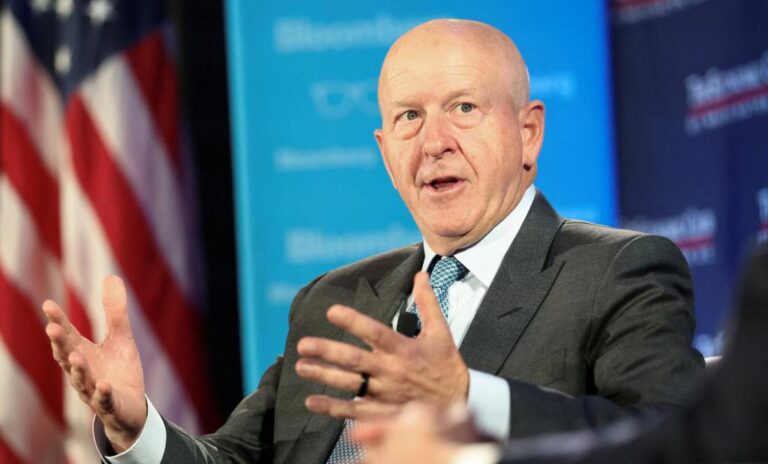
David Solomon, the chief executive of Goldman Sachs and once a noted cryptocurrency skeptic, has disclosed that he personally owns Bitcoin.
Speaking Wednesday at the World Liberty Forum hosted at President Donald Trump’s Mar-a-Lago club in Palm Beach, Florida, Solomon described his holdings as “very little, but some” Bitcoin. The 64-year-old Wall Street executive did not reveal the value of his investment or how long he has held the digital asset.
His admission comes as Bitcoin trades below $70,000, retreating from recent market highs.
From Skepticism to Strategic Monitoring
Solomon, who succeeded Lloyd Blankfein as CEO in 2018, previously characterized cryptocurrencies as highly speculative — a sentiment that once echoed widely across Wall Street. In 2021, his counterpart at JPMorgan Chase, Jamie Dimon, famously argued that Bitcoin had “no intrinsic value.”
Yet the tone among financial leaders has shifted in recent years. At the Mar-a-Lago event — hosted by Eric Trump and Donald Trump Jr. — Solomon said he continues to closely monitor developments in digital currencies as part of broader financial technology trends.
He emphasized that traditional finance and cryptocurrency should not be viewed as competing systems.
“It’s one system; it’s our system,” Solomon said. “We have to do it the right way.” He added that digital tokens will be “super important” in the future of finance.
Goldman’s Deepening Crypto Footprint
While Solomon’s personal Bitcoin stake may be modest, Goldman Sachs’ institutional engagement with digital assets has expanded significantly under his leadership. The bank has launched cryptocurrency trading desks and custody services aimed at institutional clients, reflecting growing demand from asset managers, hedge funds and corporations seeking exposure to digital assets.
The broader regulatory climate has also evolved. Under the second Trump administration, Washington has adopted a comparatively light-touch approach toward cryptocurrency oversight, contributing to renewed momentum across the sector.
How Bitcoin Works
Bitcoin operates independently of central banks and governments, enabling peer-to-peer transactions on a decentralized network. Transfers can offer a degree of anonymity, a feature that has attracted users seeking privacy in their financial activities.
The cryptocurrency is created through a process known as mining. Specialized computer operators — known as miners — verify transactions by solving complex mathematical puzzles. In return for validating transactions and securing the network, miners receive newly issued Bitcoin. The digital coins can then be traded online and converted into cash at prevailing market prices when deposited into financial accounts.
A Sign of Wall Street’s Changing Attitude
Solomon’s disclosure underscores how dramatically Wall Street’s perception of cryptocurrencies has evolved. What was once dismissed as a speculative fringe asset is now increasingly integrated into mainstream financial infrastructure.
Although Solomon’s personal exposure is limited, his acknowledgment reflects a broader transformation within the financial industry — one in which digital assets are no longer viewed solely as rivals to traditional finance, but as an emerging component of it.